
 Moving from one year towards the next has me thinking about summer camp in the past and future. For over a century, summer camps in the United States have helped millions of American children develop and grow as well as start negotiating their worlds outside of immediate families and neighborhoods. At first, a small number of elite camps only served boys, and primarily Protestant boys at that — but by the time the prosperous years after World War II were in full swing, approximately one in six American children went to camp, usually for eight weeks at a time. Throughout the 20th century, camps changed to serve all children including varying camp lengths, welcoming girls, and opening their gates to all races.
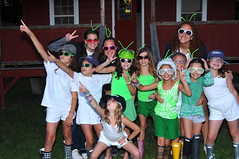 As summer camps have become more inclusive, the world that children experience both in the United States and globally has also become very different. Many children have access to a much broader world through travel, moving images, or other technologies, but some things just haven’t changed. For instance, our pre-college age identities are still informed by interactions with peers and people connected to our individual worlds, directly translating to the people we make direct contact with. While community is still central to human development, many of our daily communities are no longer bound by neighborhood blocks tied to local shared institutions and celebrations. Our families and extended social circles filter across state, nation and even electronic borders.
SO, since children today live in this exciting world of shifting boundaries most months of the year, summer camp is the perfect environment to find time for nurturing our human need to create community. For the past century and through some necessary changes, the basic premise of summer camp has remained the same—camp is a designated, safe space dedicated to fostering and experiencing community life, personal development and skill-building. Each year as improvements are made to camp facilities and other choices, some things don’t change, like living in cabins or bunks, daily activities together, arts and crafts, hikes, water and land sports, singing camp songs and roasting marshmallows around campfires to name a few! Lessons learned at camp and friendships made there can provide the “glue” to help children become well-rounded adults in the future.
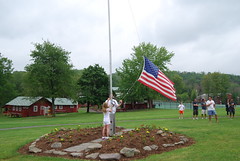 Past, present and future campers are all part of a lively and creative shared community where remembering a song, a person, an event, a skit, food or a poignant moment can instantly transport peers back to camp. So, what you would add to a time capsule to “capture” the timeless spirit of camp and why? We’d love to hear what alumni and present campers would include in an electronic time capsule, so get scanning or writing up those memories and lessons learned! If you’re not sure how to get started, ask questions in the comments below!
Deb

Thank to openDemocracy for the image.
 Whether your Holiday Season has ended or is about to begin, summer camp season isn’t far away! In fact, on December 8th 2010, next year’s campers wore their camp shirts in numerous cities to mark the 200 Day Countdown To Summer. If you’ve never gone to camp, it may be difficult to understand what drives this passion for camp all year—but campers know that camp is contagious, FUN, and essential! The camp experience helps children develop into well-rounded adults in enormous and complex ways, and that’s really important—but having FUN and intense youthful experiences is how it all happens. That’s the brilliant combination of camp. The experience includes serious AND hilarious moments—often simultaneously! The whole experience is much like the two sides of a single coin, or the double-faced image of Janus, the Roman god who can see into the past and future at the same time—and the origin of the name for the first month—January.
 The serious side of camp includes feeling part of a unique community, identity development and participating through the years to make irreplaceable memories. If you don’t understand why camp is such an important American institution, in 1998 Ira Glass and the This American Life radio program attempted to investigate the topic—
 It also highlights how fun, tradition, stories, community and being human are all part of identity development at camp. With his signature quirky style, Ira assembled more “truth is stranger than fiction tales,” where real campers tell stories of camp in days gone by and explain why the camp experience is so special. Hundreds of campers responded to his call for stories and the program shares a selection, so if you’re interested in history and interpreting American culture, you’ll find the reminiscences fascinating. Just remember that all camp experiences are not like the stories told—the point of the program is to illustrate the intensity of the experience! It ends with campers talking about becoming camp alumni and how their camp experiences won’t ever be forgotten.
 As we all know, time passes and our camp years are limited by the fact that we’re only children once. It’s easy to feel briefly melancholy at year’s end as time waits for no one, but of course, December also means that the promise of a new year is around the corner! In January, we’d like to continue looking backwards and forwards while thinking about camp and we’d especially love to hear from camp alumni. What’s the funniest thing that happened to you at camp? How did camp contribute to your adult life? We’d like to hear about the memories you hold dear and close to your heart, or what you wish for campers next year? If you’re counting the days until camp starts, what are YOU planning?
 What do camp counselors learn at camp that helps them later in life? The specific answers to that question are varied, but one thing remains constant—camp has a big impact on individual lives long after campers grow out of their camping and counselor years. Recently
  Kelly learned that “being a camp counselor is all about leading a group of people into enthusiasm,” and that continues to be important in her job today. Just as campers and staff still gather each summer—sometimes for the first time and sometimes after waiting all year just to come back—Kelly went to camp! There, learning, personal growth, fun and friendship blossomed during intense times and life-long skills and ideas were forged. Camp operates as a microcosm of experiences that mirror real-life situations as everyone negotiates friendships and different personalities, tries new things and finds their unique role in the group. If you’ve been a camper or a counselor, you know what I’m talking about. You also know that facilitating fun and teamwork takes creativity and enthusiasm. (If you’re thinking about being a counselor, camp is an incredible way to learn skills and prepare for future jobs!)
 Another famous camper, Disney’s
  In
In 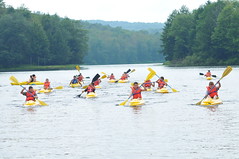 If you’re in Louv’s age bracket, you may also recall a childhood filled with a kind of free, natural play that today seems like an antique artifact compared to current kid’s lives. Lives filled with mobile devices, instant messaging, screen time, digital games and fears of “things” outside. In his book, Louv explores “the increasing divide between the young and the natural world, as well as the environmental, social, psychological, and spiritual implications of that change.” He discusses the accumulating research that implies that secure children (and adults for that matter) must connect with nature to fully develop. This need for contact with the natural world is as imperative as good nutrition and adequate sleep. So, while multiple reasons give us less and less time to connect outdoors, more and more studies suggest that embracing nature is a human necessity.
 Louv discovered that
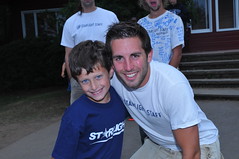 In contrast, one past camp counselor explains, “time management is crucial at camp,” and even if you are familiar with regimented schedules, “a camp counselor is responsible for keeping others in line with the daily schedule.” So the job requires not only learning to manage time personally, but also for large groups and that becomes a skill counselors develop. Camp counselors also “learn to be disciplinarians in strategic ways.” These skills are essential and applicable to keeping an undergraduate student motivated to complete assignments and participate in college activities. So, since professional experience at camp requires “all counselors to be responsible,” and to “learn to be accountable for personal actions as well as those of others,” camp counselors benefit in multiple ways.
 2. Independence and freedom
 According to American Camp Association
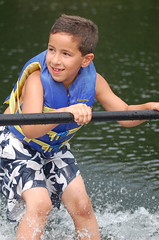 As children mature, they continue to develop and require more experiences where they can make independent choices without parents. If parents don’t allow children to make decisions and do things on their own, they won’t develop confidence or realize that they are not just extensions of their caregivers. It’s a tricky line that parents walk! Sometimes giving children room to spread their wings seems counter intuitive, but in order to grow into a self-reliant adult, children need to struggle without the offer of a quick fix. Even when parents can take care of things, the better choice is to support a child through the process of working through and solving problems. Long after a problem has been forgotten, a self-reliant child will remember hearing, “Wow! You amaze me! You really worked hard to figure that out.”
 Of course, the
  According to the
 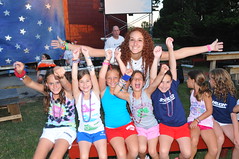 Bunkmates must also learn how to navigate the waters of communal decisionmaking. They must work through the inevitable issues and conflicts that come up in bunk living — and they must learn to adapt and get along when things don’t go their way. They learn to live by the will of the majority, while at the same time respecting the needs of others who represent the minority. Again, according to the ACA, “small group living also provides the necessary intimacy for individuals to achieve a sense of belonging, explore a variety of group roles, cooperate and form relationships with others, and have input into the group’s activities”.
 Although sometimes I am annoyed with how much of my life occurs online, there’s no arguing that modern social networking has helped nurture the lifelong friendships developed at camp. Now, instead of waiting days or week from a letter from a camp pen pal, you can send a text message, IM, or just nudge them on Facebook. Many camps have Facebook groups, some devoted exclusively to alumni from certain years, so the 50-somethings reminiscing about camp in the 70s can be a subgroup of a larger online camp community.
 As parents, we are always on the lookout for experiences that help our children learn new skills. We enroll them in music lessons, martial arts, sports, theatre, choir and, of course, summer camps. But we all know that the best programs (and the best educational experiences) are ones that go beyond the basics of teaching skills to help develop our children’s character. The basics of
 “I felt like they were living a free life,” she says. The rules were there, just not stressful. This kind of independence creates the necessary space for the foundations of character to blossom. “I could not believe the person he had become – just a new person – totally confident in himself,” she says.
 How would you describe the essential elements of a summer camp? Do the adventures of spending days with peers, learning new skills, trying new activities, bonfires and skits, great counselors— all the fun of the whole experience— first come to mind? These are definitely important elements of summer camp from a camper’s perspective, but there are a lot of other elements that have to be in place for a camp to be successful year after year. Have you ever wondered what it takes to set the scene and develop communities where good times can take place? I have.